
AC Won't Turn On? Here's What to Check
Most of the time it is the thermostat, the breaker, or the filter. Check those three first, in that order, and stop the moment a breaker trips twice.
- ✓21-point audit in full
- ✓Call direct, no forms to fill
- ✓Serving Montgomery, Prattville & Wetumpka
Why won't my AC turn on?
An AC that will not turn on is usually stopped by something simple: the thermostat is not calling for cooling, the breaker has tripped, or the drain float switch has cut the power. The answer is to check those in order, and to stop the moment a check points at a fault instead of a setting.
Work through the four safe checks below. Each one takes a minute, and each one rules out a cause. If none of them brings the system back, the fault is inside the unit, and that is where the safe checks end.
- Thermostat first: Cool mode, setpoint below room temperature, fresh batteries if it uses them.
- Breaker second: a tripped breaker can be switched back on once, and only once.
- Filter third: hold it up to a light, and replace it if you cannot see through it.
- Drain fourth: a full drain pan or a wet ceiling means the float switch has done its job.
- Our page on AC repair in Montgomery covers the same checks on a repair visit.
What should I check first: thermostat, breaker, filter?
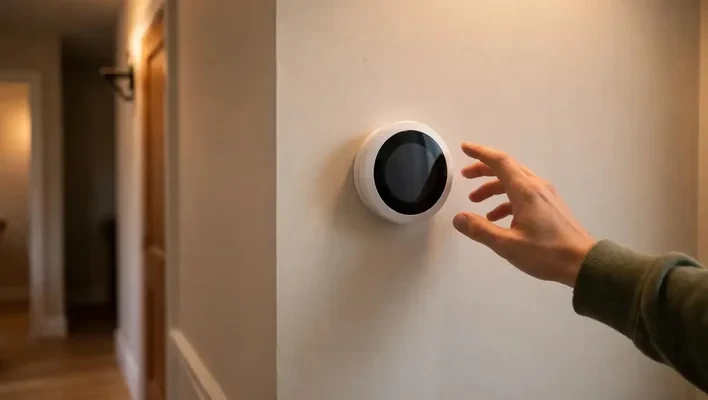
Start at the thermostat. Set it to Cool, set the temperature a few degrees below the room temperature, and check the fan is set to Auto. If the display is blank or dim, replace the batteries. A thermostat that is set to Heat, or set above the room temperature, is not calling for cooling at all.
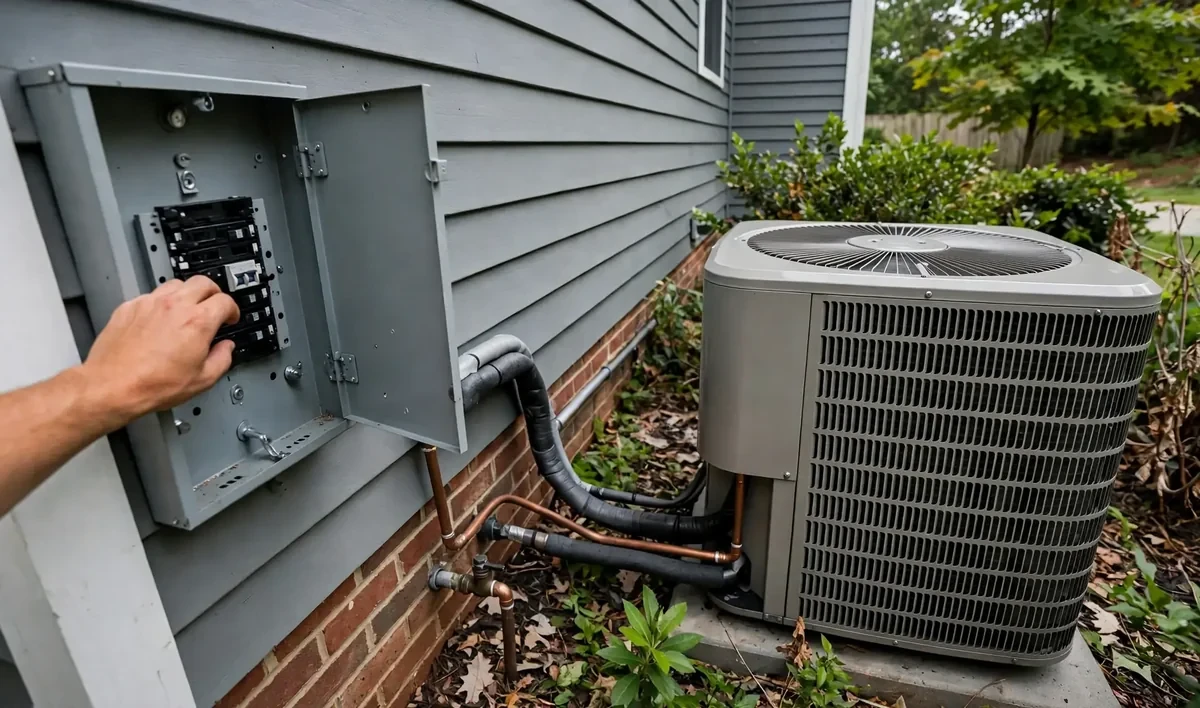
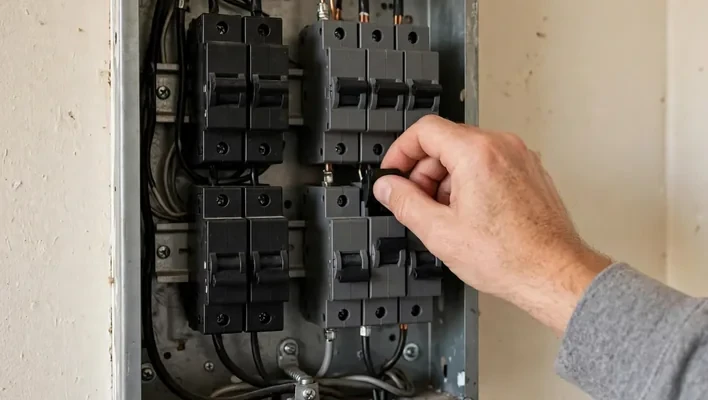
Then check the breaker panel and the outdoor disconnect switch. Switch a tripped breaker back on once. If it trips again, leave it off and call. Then check the filter, and clear leaves and stored items away from the outdoor unit so air can move.
- Thermostat: Cool mode, setpoint below room temperature, fan on Auto, fresh batteries.
- Breaker: reset once only. A second trip means a fault, so leave it off.
- Outdoor disconnect: check it is switched on after a storm or a power cut.
- Filter: replace it if you cannot see light through it.
- Do not open the electrical panel beyond the breaker. The inside of the panel is technician-only.
What does a hum or a click mean?
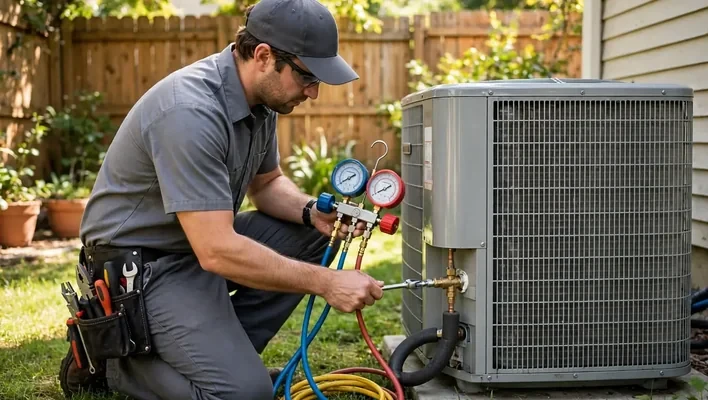
A hum with no fan movement often points at a failed capacitor, the part that gives the fan and compressor their starting push. A click with no start often points at the contactor or the control board. Both are electrical parts, and both are tested with a meter, not by looking.
Note what you heard and when it started. A hum that began after a storm points a different way than a hum that has been getting louder for weeks. Either way, the unit stays closed. Opening it puts you next to live parts, and the fault is found faster with a meter than with a guess.
- Hum, no fan: often a failed capacitor. Note it and call.
- Click, no start: often the contactor or the control. Note it and call.
- Buzz or burning smell: switch the system off at the thermostat and call.
- Do not keep resetting a breaker that trips again, and do not open the outdoor unit.
- What the technician checks is on our AC repair page: capacitor, contactor, and control, in that order.
When should I stop and call?
Stop and call when the breaker trips a second time, when you smell burning, when you hear a buzz from the outdoor unit, or when you see water near the air handler. Stop too if the drain pan is full, the ceiling is wet, or the system starts and stops every few minutes.
Montgomery storms can trip a breaker or a disconnect, so check those first after a storm. If the power is out across the house, check with Alabama Power on 1-800-888-2726 before calling about the AC. The outage number is for the power check only, not for AC diagnosis.
- Breaker trips twice: leave it off and call.
- Burning smell or buzz: switch the system off at the thermostat and call.
- Water near the air handler: switch the system off and call.
- System starts and stops every few minutes: call, and leave it off if it keeps cycling.
- Call with the symptom in your own words, and the technician confirms timing on the call.
Your questions, answered
The most common causes are the thermostat setting, a tripped breaker, and a condensate drain that has triggered the float switch. Check the thermostat, the breaker, the filter, and the drain first. If the breaker trips again after you switch it back on once, leave it off. That is a fault, not a reset problem.
Start at the thermostat: Cool mode, a setpoint below room temperature, and fresh batteries if it uses them. Then check the breaker and the outdoor disconnect, then hold the filter up to a light. If you cannot see through it, replace it. These four checks rule out the easy causes before a visit.
A hum with no fan movement often points at a failed capacitor, and a click with no start often points at the contactor or the control. Both are electrical parts inside the outdoor unit. Do not open the unit to look. Note what you heard and when, and call. The technician tests the part with a meter.
Stop and call when the breaker trips a second time, when you smell burning, when you hear a buzz from the outdoor unit, or when you see water near the air handler. Stop too if the drain pan is full or the ceiling is wet. These are faults, not settings, and they need a technician.
After a storm, check the breaker and the outdoor disconnect first, because a surge can trip either one. Clear leaves and branches away from the outdoor unit so air can move. If the power is out across the house, check with Alabama Power on 1-800-888-2726 before calling about the AC.
Still not starting? Call with what you checked
Checked the Thermostat, Breaker, and Filter? Call With the Result
Tell the technician what you checked and what happened. That is enough to start the visit.
Want the Full Check Sequence?
Read our page about AC repair in Montgomery, the same safe checks, the stop points, and what a technician checks on the visit.
A dead AC in July is a comfort problem first, and a fault second.
- Montgomery summers average a high of 94°F in July, so a dead AC is not a wait-and-see problem.
- The same visit process covers Prattville homes and Wetumpka homes too.
Find us
Find Cloverdale HVAC in Montgomery
Cloverdale HVAC 714 E Main St, Prattville, AL 36067.